You know that moment in the grocery checkout line when your 5-year-old asks why the candy bar is "just one dollar" and you can't have it? That's the moment most parents realize they've been waiting too long to start the money conversation.
The good news is, you don't need a big sit-down talk. You don't need a curriculum, a chart, or a finance degree. (Good news for me too — I still calculate 15% tips on my fingers.) What you need is the willingness to say a few small things, in a few small moments, before the next checkout-line question.
Start with what money does, not what it is
Most kids understand trading long before they understand value. My son once tried to buy my coffee with three Cheerios. He had the concept of exchange perfectly. He just didn't yet know that not everything trades equally.
So skip the long definition of currency. Try this instead: "Money is what grown-ups use to trade for things we need or want, like food and clothes and toys." That's the whole foundation. Everything else builds on top.
Use moments, not lessons
You don't have to schedule money education. It schedules itself, multiple times a week, in places you're already going.
In the grocery store: pick up two similar items, name the prices, ask which one your kid would pick. "This box has eight cookies for four dollars. This box has twelve cookies for five dollars. Which feels like a better deal to you?" They'll get it wrong sometimes. They'll learn anyway.
In the toy aisle: don't say no to everything. Say "If you could pick only one of these, which would you pick?" Watch what happens to their face. They're doing math you didn't teach them.
In the kitchen, after the tooth fairy comes: "You have three dollars now. Want to keep it all in one jar, or split it into save-spend-share jars?"
Each of these takes thirty seconds. None of them feels like a lecture. All of them stick.
Start small with three jars
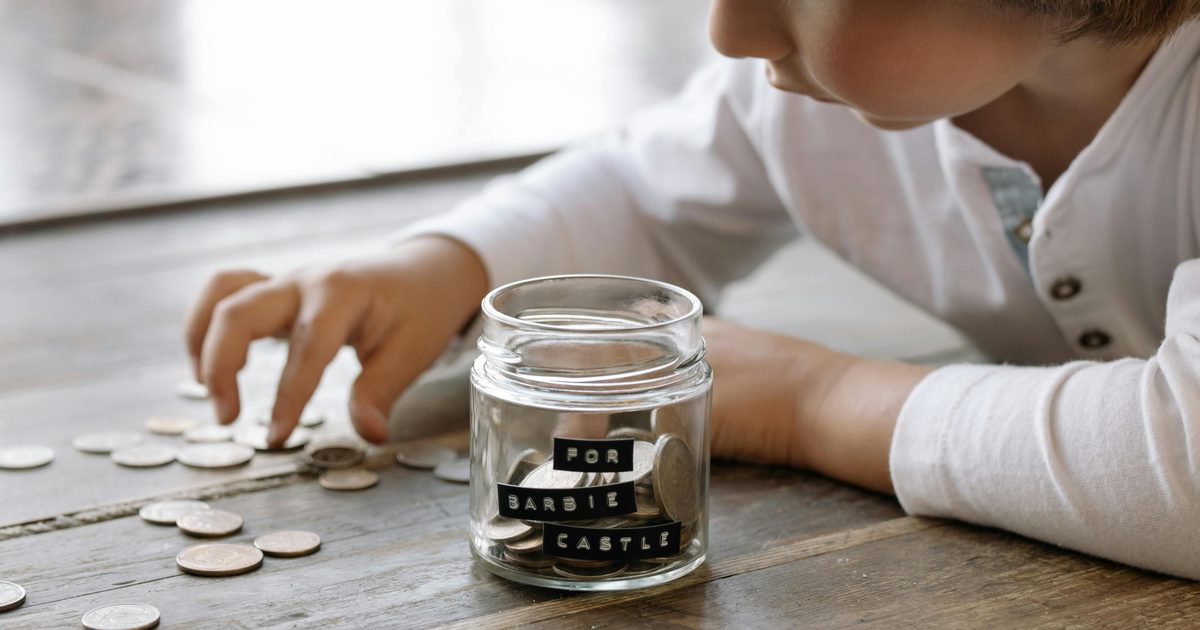
If you do nothing else from this list, do this one thing: get three clear jars. Label them Save, Spend, Share. Let your kid decorate them with stickers, markers, glitter glue if you can stand it.
Every time money comes into your kid's hands — birthday cash, tooth fairy, allowance, found quarters under couch cushions — it gets sorted between the three jars. They decide. You witness.
That's the whole system.
What happens next is wild. Within a few weeks, your kid starts asking "which jar?" unprompted. They start telling you what their Spend jar has, what they're saving for, who gets the Share. Money has become tangible, sortable, theirs.
When they don't get it, that's normal
Kids forget. They re-ask the same questions. They confuse dollars and quarters. They want to put all the money in Spend, every time, until one day they don't.
This isn't failure. This is how learning at this age works. Repetition is the lesson, not a sign you're doing it wrong. The same question asked three times in three months isn't your kid being slow — it's your kid checking that the rules haven't changed.
Five minutes a week
That's the actual time investment. Five minutes a week, spread across the moments that already exist. The grocery line. The toy aisle. The dinner-table chat about why grandma sent a gift card.
The kids who grow up most comfortable with money aren't the ones whose parents sat them down for a finance lecture. They're the ones whose parents made money a normal, casual, talked-about part of family life. The kind of family where you can say "we have enough" or "we're saving for that" without it feeling like a Big Serious Moment.
You can be that kind of family starting tomorrow.